

 Jun 03,2026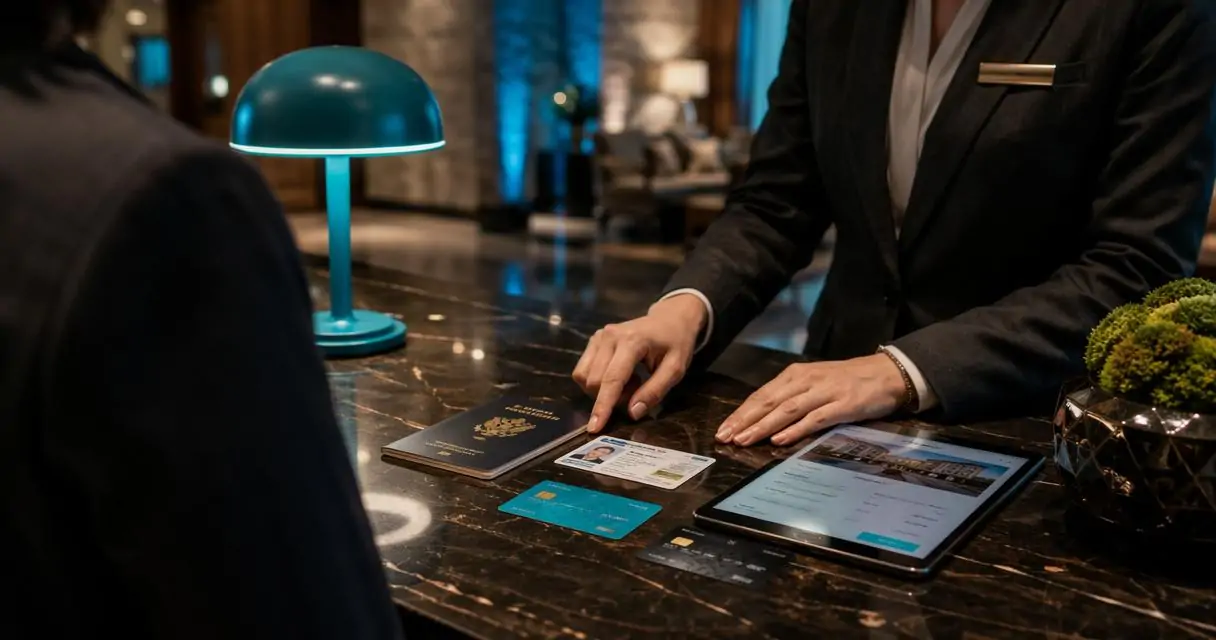
TL;DR
Front desk fraud usually shows up as a pattern, not a single clue: mismatched ID details, rushed behavior, unusual payment requests, and reservation inconsistencies. The safest response is a calm verification workflow that documents signals, protects legitimate guests, and escalates only when multiple red flags appear.
Hotel check-in fraud red flags matter because the front desk is where identity, payment, inventory, and guest safety meet in real time. A guest who presents a mismatched ID, resists card insertion, changes arrival details repeatedly, or pushes staff to bypass policy may be creating a loss before the room key is issued.
Hotel check-in fraud: an attempt to obtain lodging, services, refunds, loyalty benefits, or access through false identity, unauthorized payment, manipulated booking details, or policy abuse during arrival.
The strongest defense is not suspicion. The strongest defense is a consistent operating process that treats every guest fairly while verifying exceptions. Properties using Innstrata can align front desk notes, guest history, and operational playbooks so staff decisions stay consistent across shifts.
Table of Contents
What are the top hotel check-in fraud red flags?
Hotel check-in fraud red flags are the identity, payment, behavior, and reservation signals that suggest a guest record needs extra verification before access is granted. The most useful warning signs appear in clusters, such as a mismatched ID plus a declined card plus pressure to skip normal authorization.
A single cue rarely proves intent. Hotels should train teams to look for patterns, document facts, and apply the same policy to every arrival. Research on anomaly detection describes the value of identifying deviations from expected patterns, a useful concept for hospitality controls as well as data systems, according to Ruff, Kauffmann, and Vandermeulen in their 2021 review of anomaly detection methods for the Proceedings of the IEEE paper.
Quick checklist for front desk teams
| Red flag category | What staff may notice | Immediate action |
|---|---|---|
| Identity mismatch | Name, photo, age, address, or signature does not align | Ask for a second accepted ID and compare to the reservation |
| Payment conflict | Card name differs, card will not insert, authorization fails | Follow card-present policy and require valid authorization |
| Reservation anomaly | Same-day high-value stay, odd room pattern, repeated changes | Review booking source, notes, and prior history |
| Behavior cue | Urgency, distraction, refusal to answer basic questions | Slow the process and involve a supervisor |
| Policy pressure | Requests to waive deposit, ID, incidentals, or registration rules | Repeat policy calmly and document the request |
Key insight: Fraud prevention improves when staff verify facts rather than judge personalities. The record should show what happened, not what someone assumed.
Training clips help front desk managers discuss behavior patterns without turning every unusual guest into a suspect. The value is in pausing the scenario and asking which policy step should happen next.
Which ID and document issues deserve extra review?
Identity issues deserve extra review when the document, reservation, payment method, and guest behavior do not tell the same story. Hotels should verify the booking name, government ID, payment name, loyalty profile, and registered occupants before issuing keys for any reservation with inconsistent details.
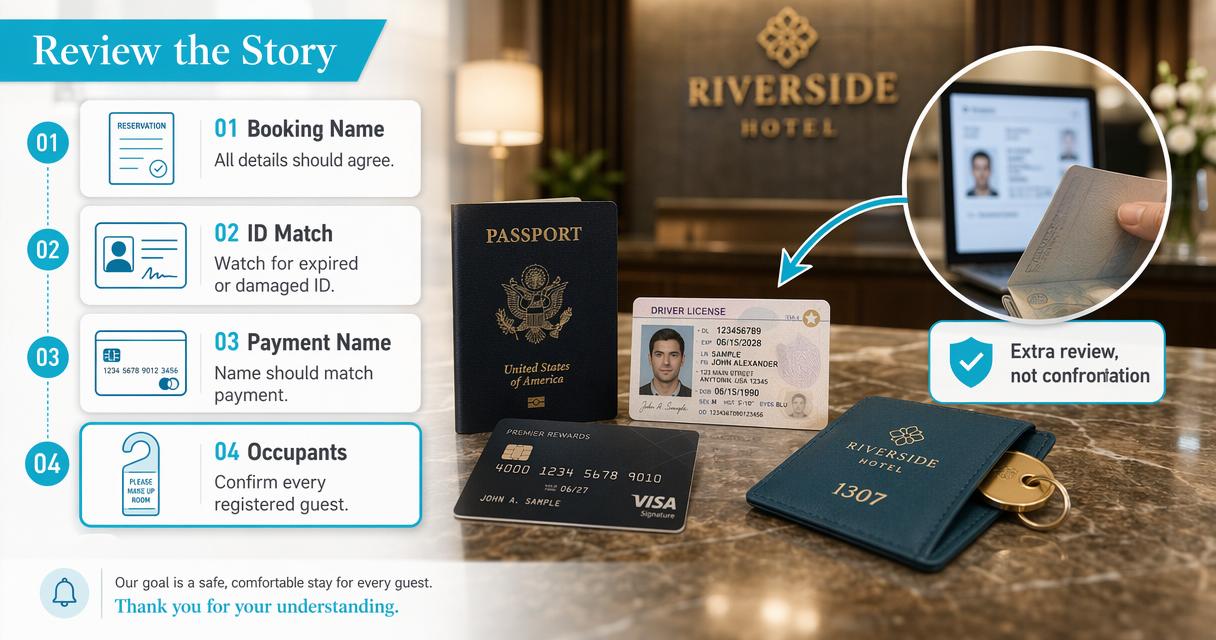
Common document problems include expired identification, damaged cards, blurry digital copies, reluctance to hand over ID, or a claim that the booking was made by an absent third party. Some legitimate travelers arrive with complicated arrangements, so the process should allow verification rather than automatic denial.
Document signals that should trigger verification
- The ID name does not match the reservation or payment card.
- The guest presents a photo of an ID when policy requires a physical document.
- The address, birthdate, or signature changes across forms.
- The guest refuses registration details that local law or property policy requires.
- The person checking in cannot answer basic booking questions, such as room type, stay dates, or rate plan.
“Trust, but verify.”, Ronald Reagan, Ronald Reagan Presidential Library
That phrase fits front desk work well. Verification protects the property, but it also protects legitimate guests whose names, cards, or accounts may have been misused.
How Innstrata supports cleaner front desk decisions
The Innstrata platform is most useful when properties want operational consistency, not guesswork. A structured check-in workflow can keep notes, policies, and guest history visible, giving managers a cleaner basis for decisions during busy arrival windows.
Properties that need a broader control stack can review hotel fraud prevention tools for independent operators to connect front desk training with payment, guest screening, and documentation practices.
Which payment and booking patterns are suspicious at arrival?
Payment and booking patterns become suspicious when a guest asks staff to override normal authorization, change payment ownership, or treat a high-risk reservation as an exception. The safest properties separate empathy from approval: staff can remain polite while requiring valid ID, card-present authorization, and deposit rules.
Sumsub’s 2026 hospitality fraud guidance lists mismatched names and online-to-check-in inconsistencies among warning signs for hotel fraud prevention analysis. That matches the front desk reality: many bad transactions begin before the guest reaches the counter, but they are often exposed during arrival.
Booking and payment patterns to review
- Same-day booking with premium inventory: confirm the source, rate, card authorization, and guest profile.
- Cardholder not present: require the property’s approved third-party authorization process.
- Multiple declined cards: stop repeating attempts and follow manager escalation rules.
- OTA confusion: verify whether the booking is prepaid, virtual-card funded, or hotel-collect.
- Deposit resistance: avoid issuing keys until the required hold or deposit is completed.
- Unusual extension requests: review folio balance before adding nights.
Hotels also need rate and channel discipline. A property that monitors unauthorized discounts and channel discrepancies through hotel rate parity monitoring for small hotel groups has a cleaner view of whether an arrival issue started with a suspicious booking source.
What payment red flags do not prove fraud
Some payment problems come from travel disruption, card limits, bank security rules, or family travel. A declined card, a tired guest, or a third-party payer is not proof of misconduct.
Fair handling means applying the same sequence every time: explain the policy, request approved documents, attempt compliant authorization, and document the result. Consistency lowers chargeback exposure and reduces the chance of discriminatory treatment.
How should front desk teams respond without escalating too fast?
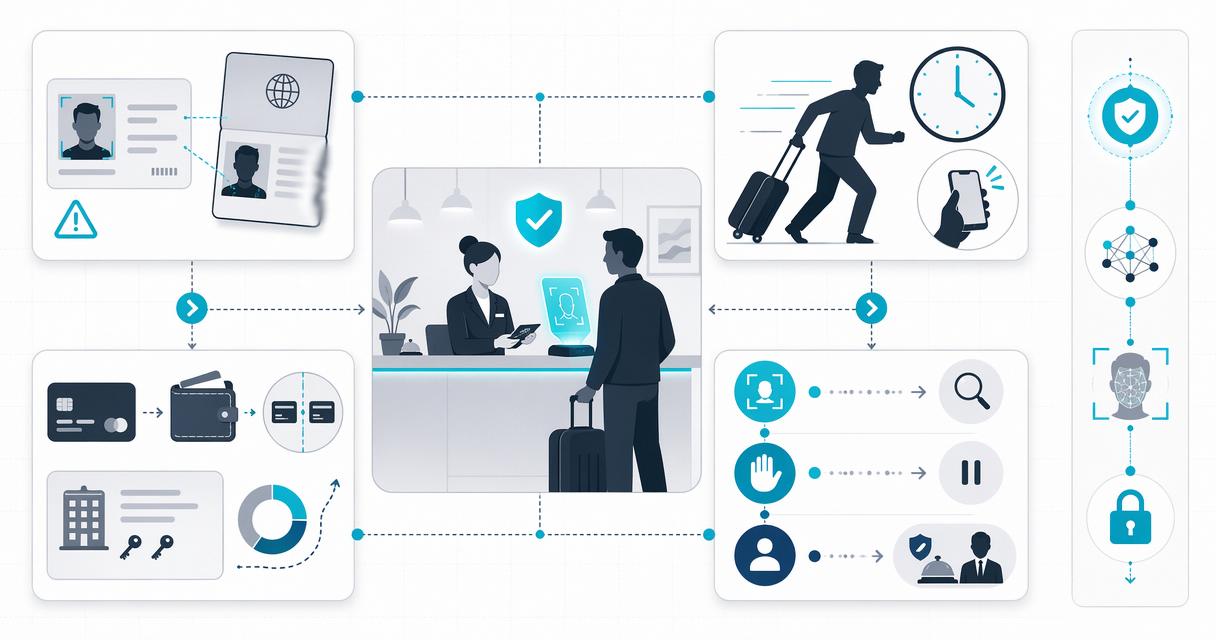
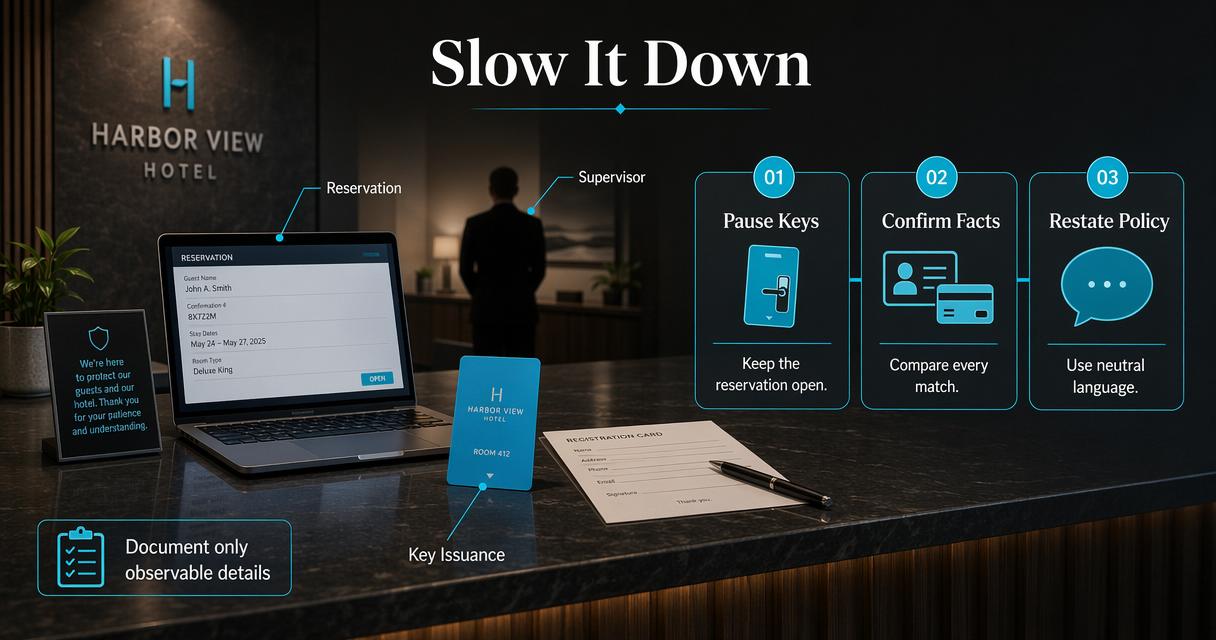
Front desk teams should respond to suspected check-in fraud by slowing the transaction, verifying required facts, involving a supervisor, and documenting only observable details. The goal is not confrontation. The goal is to prevent unauthorized access while giving legitimate guests a clear path to complete check-in.
One-page escalation protocol for arrivals
- Pause the key issuance: keep the reservation open, but do not encode keys until required checks pass.
- Confirm identity: compare the booking, ID, payment method, and registration card.
- Restate policy: use neutral language, such as “The property requires card-present authorization for incidentals.”
- Ask for approved alternatives: second ID, verified cardholder form, or another accepted payment method.
- Call a supervisor: escalate when two or more warning signs appear or when staff feel pressured.
- Record facts: document time, names, policy steps, authorization results, and guest responses.
- Protect safety: contact security or law enforcement only when threats, trespass, stolen documents, or illegal activity are involved.
Front desk rule: no room key should be issued when identity, payment, and reservation ownership cannot be connected through approved property procedures.
Language that keeps the desk calm
Calm language reduces friction and gives staff a script during pressure. Good phrases include:
- “The reservation can continue once the required authorization is completed.”
- “A supervisor can review the approved options.”
- “The policy applies to every guest for account security.”
- “The property can hold the booking while valid documents are provided.”
Independent properties can also improve controls by sharing high-risk guest notes through a compliant, policy-based process. For deeper guidance, see shared do-not-rent list practices for hotels.
What will change for fraud prevention in 2027?
Hotel fraud prevention in 2027 will depend more on connected records, digital identity checks, and staff decision support than on instinct alone. As mobile check-in, virtual cards, synthetic identities, and AI-assisted scams grow more common, properties will need controls that work before arrival and at the desk.
The next shift is operational: fraud checks should be built into reservations, payments, housekeeping access, and incident reporting. Standalone binders and memory-based training will not be enough for small portfolios that operate across multiple shifts.
Controls likely to matter most next year
| 2027 control area | Why it matters | Practical hotel action |
|---|---|---|
| Digital ID review | More guests will arrive through mobile-first flows | Define when physical ID is still required |
| Guest history visibility | Repeat incidents may span properties or shifts | Standardize notes and manager review |
| Virtual card validation | OTA payment flows remain complex | Train staff on prepaid versus hotel-collect rules |
| AI-assisted social engineering | Scammers can create more convincing messages | Require staff to verify through approved channels |
| Demand-aware staffing | Fraud risk rises when desks are rushed | Forecast arrivals and schedule supervision |
Better staffing also lowers risk. Properties using demand planning from resources such as independent hotel room-demand forecasting can place experienced managers on high-arrival nights. Innstrata can support that discipline by making operational patterns easier to review across the property.
FAQ about check-in fraud warning signs
Common questions about hotel check-in fraud red flags usually center on proof, guest privacy, and when to refuse service. The best answers rely on policy, documentation, and manager review rather than instinct.
Can a hotel refuse check-in because of a suspicious payment card?
A hotel can usually refuse check-in when the guest cannot meet published payment, identity, deposit, or registration requirements. Staff should avoid accusing the guest of fraud. The safer approach is to state the requirement, offer approved alternatives, and document the reason keys were not issued.
Is a third-party booking always a fraud risk?
A third-party booking is not automatically risky. Risk rises when the cardholder is absent, the authorization form is missing, the booking name differs from the guest ID, or the guest cannot explain the reservation details. Clear policies for corporate, family, OTA, and prepaid bookings reduce confusion.
What should be written in the front desk notes?
Front desk notes should include observable facts: document type checked, authorization result, policy explained, supervisor contacted, and guest response. Notes should avoid insults, guesses, medical comments, or personal judgments. Clean records help managers, payment processors, and legal advisers review the event later.
How can small hotels train new staff quickly?
Small hotels can train new staff with a short checklist, three role-play scenarios, and a manager-approved escalation script. The training should cover ID checks, card-present rules, third-party authorizations, and when to pause key issuance. Refresher drills work best before peak arrival periods.
Conclusion
Hotel check-in fraud red flags are most useful when they trigger verification, not panic. The strongest approach combines a written checklist, consistent payment rules, clean staff notes, supervisor escalation, and fair treatment for every arrival.
A property seeking stronger operating discipline can map the checklist above into daily training, reservation review, and night-audit follow-up. For tools and practical hotel operations guidance, visit innstrata.com and review how Innstrata supports independent hotel teams that need clearer decisions at the front desk.