


 Mar 19,2026
Why So Many Travelers Think They Book Direct (But Don’t)
A rigorous, source-backed guide for travelers (and hotels) on copycat hotel websites, fake reseller domains, OTA impersonation, phishing booking pages, Google ad impersonation, and duplicate/fake listings—plus a simple verification flow you can follow before you pay.
Important: This guide distinguishes between (a) legitimate third-party resellers that may still confuse travelers, and (b) outright criminal phishing/fake-listing scams. Regulators including the Federal Trade Commission have pursued deceptive hotel-reservation marketing practices, and major platforms publish anti-phishing guidance.
Summary
If you only remember one thing: ignore “Sponsored” labels until you verify the actual domain, and never re-enter card details from a link sent by message or email—type the hotel or platform address yourself.
Why this is happening
The Federal Trade Commission has explicitly recognized a pattern: consumers searching for a specific hotel can be misled by third-party search ads and webpages that are not sufficiently transparent about who is selling the room, causing consumers to believe they are booking directly with the advertised hotel.At the same time, Google maintains advertising policies intended to prevent misleading ads and phishing, including policies addressing misrepresentation and phishing as an “unacceptable business practice”. These policies exist because deceptive ads undermine user trust—and because scams routinely attempt to blend in with real brands.What makes hotel bookings uniquely vulnerable is that they combine: (a) high purchase intent (“I need a room tonight”), (b) high dollar amounts, (c) complex fee structures, and (d) legitimate intermediaries (OTAs, wholesalers, affiliates) that can create confusion even without criminal intent. Regulators and consumer agencies repeatedly warn that urgency, unexpected links, and unclear total pricing are recurring risk signals in travel scams.The main scam patterns
Copycat hotel websites and “reseller” domains that look official
Some third parties operate as travel agents or resellers and may present hotel photos, hotel names, and booking paths that look “official” to a rushed traveler. In a well-known enforcement action, the Federal Trade Commission alleged certain hotel room resellers misled consumers through ads, webpages, and call centers that caused consumers to mistakenly believe they were reserving rooms directly from the hotel, including issues around when cards were charged.Separately, consumer-facing reporting has described cases where travelers paid substantially more via lookalike booking websites that added service fees on top of taxes, compared to booking on the hotel’s own site. The Wall Street Journal described an example in which a third-party site, Guest Reservations, added significant fees compared with the property’s direct taxes.Not every reseller is a scam—but if you thought you were booking direct and you weren’t, you can still end up with different cancellation or refund rules, extra service fees, or more friction when something goes wrong.
Phone scams: “We are the hotel” calls (most common trap)
One of the most common ways guests get tricked today isn’t even online — it’s over the phone. Guests search for a hotel, click a number they believe is the front desk, and unknowingly call a third-party reseller or call center pretending to be the hotel.How the scam works step-by-step
- Guest searches hotel on Google
- Clicks a phone number from an ad or third-party listing
- Call is routed to a reseller call center
- Agent says: “Yes, this is the hotel, how can I help you?”
Common tactics used during these calls
- Overpromising rooms: “We can guarantee you a suite / specific view / special room type” (even if not actually available)
- False urgency: “Only 1 room left at this rate — I can lock it in now”
- Acting like front desk staff: Using hotel language, policies, and tone
- Skipping transparency: Not clearly stating they are a third party
- They were charged a high service or booking fee
- The room type promised is not guaranteed or incorrect
- The hotel has no control over the reservation
- Refunds or changes become difficult or impossible
Why this works so well
This tactic is effective because:- Guests trust phone conversations more than websites
- The agent sounds like real hotel staff
- The guest believes they already reached the hotel
- There is pressure to book quickly
How to avoid phone booking scams
- Always use the phone number from the hotel’s official website
- Do not trust numbers shown in ads or unknown directories
- If unsure, hang up and search the hotel directly
- Ask clearly: “Are you the hotel front desk or a third-party booking service?”
Why booking direct protects you
All of these scams — fake websites, phishing links, and phone impersonation — rely on one thing: creating confusion between the guest and the hotel.Booking direct removes that confusion.- You know exactly who you are paying
- You speak directly with the hotel staff
- You get accurate room availability and details
- You avoid hidden third-party fees
- You have better support if something goes wrong
Takeaway
“If you didn’t use the hotel’s official website or verified phone number… you might not be dealing with the hotel at all.”
Google ad impersonation and brand confusion
Paid search placement can amplify lookalikes. This is why Google publishes advertising policies around misrepresentation and explicitly prohibits phishing as an unacceptable business practice.For hotels, this also explains why brand protection often involves filing ad-related complaints, including trademark complaints, and monitoring how advertisers use the brand in ad text and display URLs, especially when the real destination domain is different.OTA impersonation and “message me to fix payment” traps
A fast-growing tactic is hijacking trust inside legitimate travel ecosystems. Security reporting and platform guidance describe scams where attackers compromise hotel or partner accounts, or spoof them, and send guests urgent messages saying the reservation will be canceled unless they verify a card. The message may contain accurate reservation details, making it feel authentic, then directs the guest to a counterfeit login or payment page.Booking.com’s partner security guidance warns that phishing emails can lead to pages that look like the real login page, and that checking the URL is critical. It also notes they will not make urgent requests without prior communication and encourages reporting suspicious messages.Expedia Group also publishes partner guidance emphasizing that messages designed to create urgency and fear are usually fake and should be verified rather than acted upon immediately.Phishing booking pages and “secret character” URLs
Modern booking phishing isn’t always a misspelled domain. Investigations describe attackers using lookalike characters in URLs or multi-step redirections to trick users into believing they are on the real site.Threat research by Sekoia.io describes a campaign where attackers compromise hotel systems or credentials and then target guests with “pay again” or “verify payment” messages, routing them to fake booking pages designed to steal card data.Duplicate and fake listings
Fake listings aren’t limited to vacation rentals. The core pattern is the same: a listing is created, or duplicated, with stolen photos and details, pushing the traveler to pay quickly, sometimes off-platform. The Federal Trade Commission warns in its rental-listing scam guidance that scammers fabricate listings and then pressure victims into rapid payment via hard-to-recover methods like wire transfer, gift cards, or crypto.Platform guidance echoes this. Airbnb’s anti-scam guidance and published guest safety materials advise users to avoid unexpected links and to type the platform URL directly if uncertain. The guidance also warns about fake listings and fake payment pages.Real-world examples and known domains
This section focuses on examples that are either verified by enforcement actions or primary documents, reported by reputable outlets, or disclosed by the website itself. Where an example is based mainly on consumer reports or complaints, it is labeled “reported” rather than “verified.”Known reseller domains that travelers commonly mistake for the hotel
| Example domain | Category | What’s substantiated | Why it confuses guests |
|---|---|---|---|
| reservationcounter.com | Reseller / room reseller | FTC press release from 2017 states Utah-based hotel room resellers settled charges alleging consumers were misled into believing they were dealing directly with hotels and that cards would be charged immediately. | Often reached via search ads, may present as hotel reservations, and terms include tax recovery charges and service fees. |
| reservationdesk.com | Reseller / booking service | A local news report described BBB and FTC warnings about deceptive third-party hotel booking websites, specifically referencing reservationcounter.com and reservationdesk.com. | Adds a booking or service fee and may appear official if clicked from ads or forwarded phone numbers. |
| guestreservations.com | Reseller, self-described travel agent | The site’s own Terms of Use describe acting as a Travel Agent, including Service Fees and tax recovery charges. | Reported by major press as appearing like direct booking and adding fees on top of taxes. Travelers may not realize it’s a third party. |
| reservations.com | Travel booking site | The site publishes terms describing Tax Recovery Charge structures for Pay Now transactions. | Its generic name can be mistaken for an official reservations page, especially if reached through ads or affiliate links. |
| reservationstays.com | Reported reseller | Labeled reported here because the evidence base in this pass was mainly consumer reporting rather than regulator action or site terms. | Hotel-name style landing pages and rushed checkout can cause travelers to believe they are booking direct. |
Note: tax recovery charges and service fees can exist in legitimate travel agency models. The consumer risk is confusion about who you’re paying and what rules apply, especially when marketing implies you’re dealing directly with the hotel.
Misleading URL patterns
The following examples are illustrative, not linked and not live, designed to show how scams and confusing resellers mimic official signals:- examplehotel-reservations.example-domain.com (wrong: not the hotel’s real domain)
- www.examplehotel.com.verify-payment.example (wrong: verify-payment path on an unrelated domain)
- booking-secure[.]example / expedia-confirm[.]example (wrong: urgency plus mismatched domain)
- www.exampleh0tel.com (wrong: lookalike character 0)
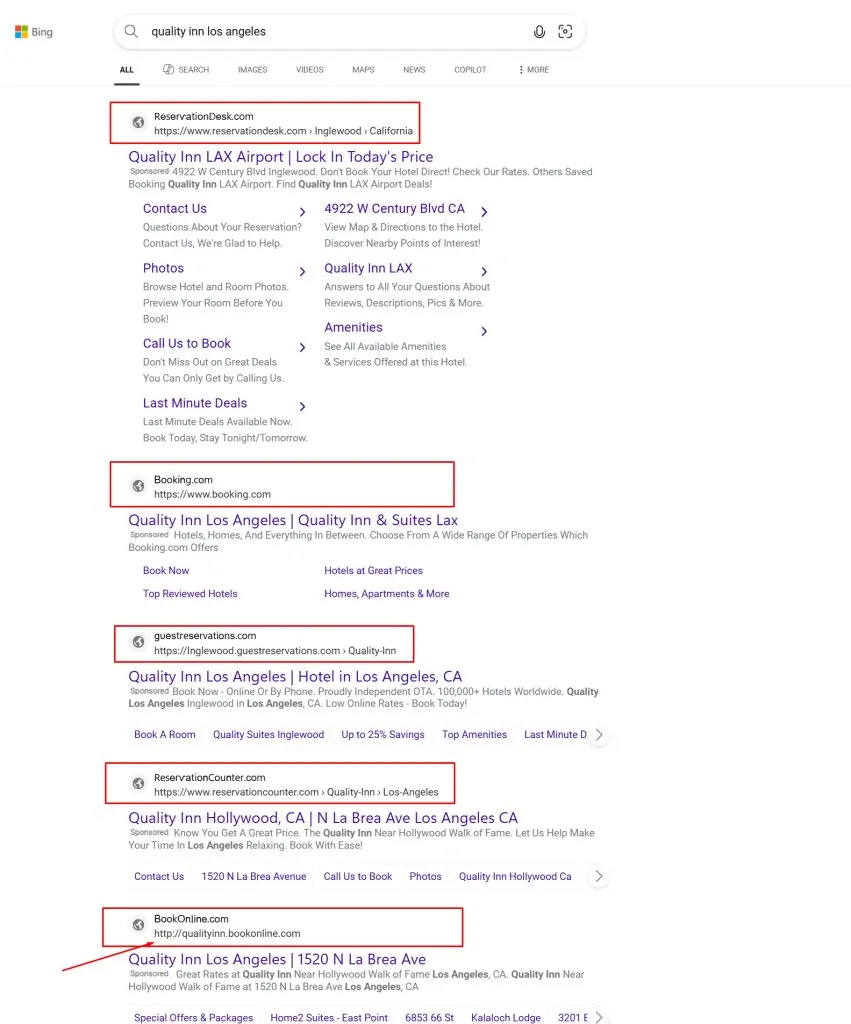
Screenshot showing sponsored reseller result above official hotel site
This is why “it looked real” is not a reliable safety test. Your safety test has to be domain verification plus independent confirmation.
Concrete steps for guests to verify the official hotel site and avoid scams
The most reliable safety strategy is to verify your booking path before you type card details. Consumer protection guidance consistently emphasizes researching the seller, verifying addresses and URLs, and avoiding unexpected links.The 20-second verification checklist
Verify your booking path
Red flags that should make you pause
- Urgency and threats like “book now or lose your reservation” or “confirm within 30 minutes.”
- External payment links sent through messages after you already booked.
- Unexpected payment methods like wire transfer, gift cards, or crypto.
- A total price that changes late or fees that show up after confirmation.
Benefits comparison: direct vs OTA vs copycat/reseller sites
| Path | Best for | Common benefits | Common risks | What to do to stay safe |
|---|---|---|---|---|
| Book direct | Most travelers who want clarity, loyalty benefits, and easiest problem resolution | Fewer intermediaries, clearer confirmation, loyalty eligibility often stronger, and less chance of being deprioritized in oversell situations. | Still must avoid fake lookalike sites pretending to be direct. | Type the URL yourself, confirm domain, and call the property if unsure. |
| Book via major OTA | Comparison shopping, bundling, and some rewards ecosystems | One account for many hotels, sometimes bundle deals, customer support channel. | Post-booking phishing via messaging is a documented threat, and hotel loyalty points or benefits may be limited on some rates. | Stay in-platform, never pay via external links, and verify payment issue messages by logging into the official site or app directly. |
| Copycat / confusing reseller | Usually not best for consumers, often accidental | Sometimes provides inventory access and call center service. | Confusion over who you’re paying, added service fees, stricter cancellation rules, higher total price, and more friction to fix issues. | Treat as not direct unless proven, compare total price, call hotel to confirm, and avoid sponsored clicks without domain verification. |
| Phishing / fake listing | Never | None | Card theft, identity theft, malware, nonexistent reservations. | Never click payment links, type URLs yourself, avoid wire or crypto, and report the site and contact your bank if you paid. |
Guidance for hotels to protect guests and defend bookings
Hotels face a two-front battle: confusing reseller marketing that siphons off direct demand, and criminal phishing that impersonates the hotel or compromises partner accounts to reach guests. Both can harm brand trust, create charge disputes, and generate front desk friction.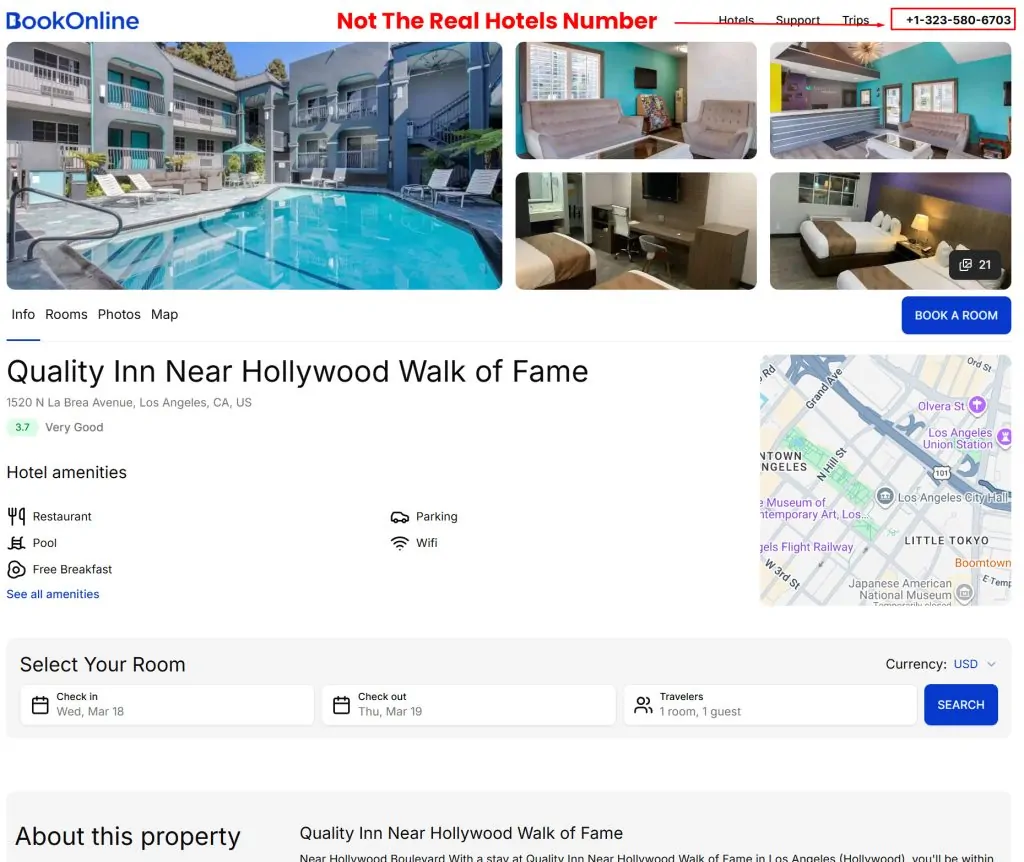
Fake booking site not using real hotel number
Reduce confusion in search
Use the policy tools that exist. Google provides a trademark complaint process and sets expectations that ads and landing pages must not be confusing or misleading about reseller status.Also document and escalate clear deception, such as ads implying official status when they are not. Google’s misrepresentation policy explicitly aims to keep ads clear and honest.Harden your organization against partner-account compromise
The threat research is consistent: attackers target hospitality staff credentials, then use access to real reservation data to message guests convincingly.- Staff training focused on phishing and urgent account lures.
- Two-factor authentication and strict access control for OTA and partner extranets.
- Process rule: never request guests re-enter card details via an external link. Publish that rule on your website and in confirmation emails.
Publish and repeat a safe booking pledge
Travelers follow patterns. Make your direct channel unmistakable:- Place your official domain prominently on signage, emails, and confirmations.
- Add a short “How to verify our official site” block on your booking page and FAQs.
- Encourage guests to call the hotel directly if they see unexpected fees or receive a payment problem message.
Align with fee transparency expectations
Confusing fee presentation is a core driver of consumer harm. Hotels that emphasize clear total price messaging also reduce the camouflage scammers use when tacking on surprise costs.Operational playbook for front desk and reservations teams
Sources
The links below prioritize primary and official sources, platform security pages, policy documents, and reputable reporting or security research.- FTC — Avoid scams when you travel
- FTC — How to avoid travel website scams
- FTC — Hotel Room Resellers Settle Charges
- FTC — Reservation Counter case page
- FTC — Report to Congress on the online hotel booking market
- Google Ads — Misrepresentation policy
- Google Ads — Trademark policy
- Google Ads — Unacceptable business practices
- Booking.com — Phishing and email spoofing guidance
- Expedia Group — Preventing phishing attacks
- Netcraft — Thousands of domains target hotel guests
- Sekoia.io — Phishing campaigns targeting Booking.com hotels and customers
- TechRadar — Major phishing attack hits hotels
- BBB — How to avoid scams when booking a hotel online
- AHLA — Search Smarter infographic
- Hotel Online — AHLA-reported research coverage
- The Points Guy — Booking direct versus third-party bookings
- Airbnb — Avoiding fraud, scams, and abuse
- FTC — Rental listing scams
- Federal Register — FTC rule on unfair or deceptive fees